> For the complete documentation index, see [llms.txt](https://guide.ston.fi/llms.txt). Markdown versions of documentation pages are available by appending `.md` to page URLs; this page is available as [Markdown](https://guide.ston.fi/swapping-on-ston.fi/blockchain-and-dex-fees.md).
# Blockchain and DEX fees
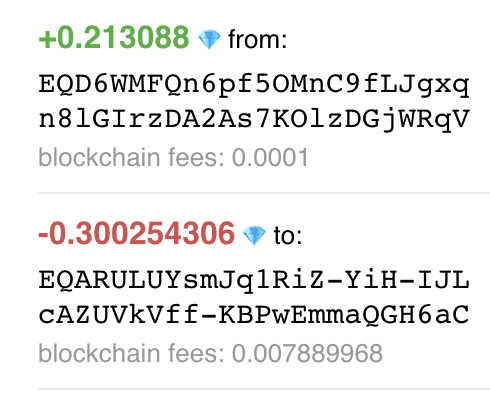
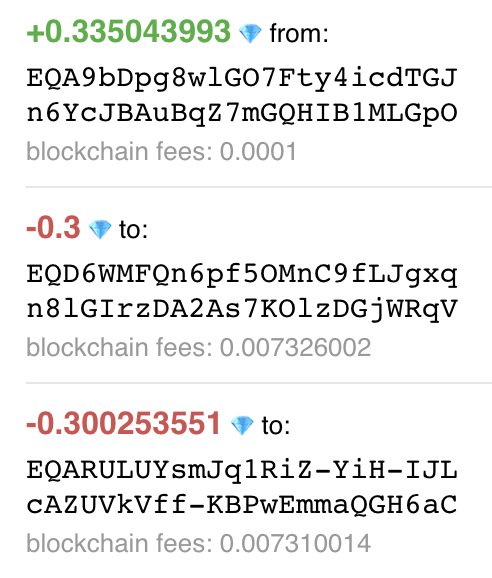
In this guide, you’ll learn how fees on STON.fi really work: what GRAM is temporarily reserved vs. actually consumed for swaps and liquidity provision, the typical cost ranges, and how pool (DEX) fees
{% hint style="info" %}
I**n short**:
✅ You always need a bit of GRAM to cover on-chain (network) fees.
✅ We reserve slightly more than the final fee so your transaction won’t fail; unused GRAM is auto-refunded.
✅ Swaps: we reserve up to \~0.35 GRAM; typical actual cost is \~0.06–0.09 GRAM, but can reach \~0.13 GRAM depending on the pool’s fee.
✅ Providing liquidity: we reserve per token (two reservations), usually up to \~0.7–0.8 GRAM total; typical actual cost is \~0.10–0.13 GRAM.
✅ DEX/trading fee (pool fee) is set per pool by its owner. A common setting is 0.30%; typically 0.20% goes to LPs and 0.10% to STON.fi, but the exact split follows the pool’s configured fee.
{% endhint %}
### Why more GRAM is “reserved”
TON network fees aren’t perfectly predictable upfront. To avoid failed transactions:
* We temporarily reserve a bit more GRAM (the “cap”).
* The unused part is sent back to you automatically right after execution.
💡 Think of it like tapping your card at a gas station: a higher hold first, then a final charge for what you actually used.
### Swaps
* Reservation (cap): up to \~0.35 GRAM (can vary by route/pool).
* Typical actual network fee: \~0.06–0.09 GRAM.
* Upper bound in some cases: \~0.13 GRAM.
* What drives it: the pool’s configured trading fee (set by the pool owner) and route complexity.
Any unused portion of the reservation is refunded.
### Providing Liquidity
* Two signatures, two network actions (one per token). Network fees are reserved separately for each token, it makes two reservations in total. Costs refer to adding liquidity; removing liquidity typically incurs slightly lower network fees.
* Total reservation: usually up to \~0.7–0.8 GRAM (both tokens combined).
* Typical actual network fee (total): \~0.10–0.13 GRAM.
* What drives it: pool configuration and whether you’re using balanced vs. arbitrary provision.
As with swaps, unused GRAM is refunded automatically.
### DEX / Trading Fee (Pool Fee)
* Who sets it: pool owner.
* Common configuration: 0.30% per swap.
* Where it goes: typically \~0.20% to LPs and \~0.10% to STON.fi.
* But: the exact fee and split follow the pool’s current settings.
🔍 You can see the trading fee in the pool details before you swap or add liquidity.
### Practical tips
✅ Keep a small GRAM buffer for fees (even if you mainly hold jettons).
✅ Check the pool’s fee (0.30% is common, but not guaranteed).
✅ Expect a higher reservation on first tries or complex routes; the final spend is usually lower.
✅ If a transaction fails, reserved GRAM is automatically returned — you don’t lose it.